
Key Takeaways
- A key that will not turn is usually one of three problems. The steering wheel lock is binding, the key is worn out, or the ignition cylinder itself has failed inside, and only the last one needs real repair work.
- Try the free fix first. Rocking the steering wheel gently while turning the key releases a bound steering lock, and that single move solves a large share of the calls people are ready to pay for.
- The key wears out before the car does. Keys are softer than the wafers they push, so a decade of daily use rounds the cuts down until the key no longer lines the ignition cylinder up correctly.
- Turning but not starting is a different problem entirely. If the key turns freely and the engine will not crank or catch, you are looking at the electrical switch or the immobilizer rather than the mechanical lock.
- A locksmith beats a tow for this job. The work happens where your car sits, and later in this guide we cover what actually comes out of the steering column and why a heavy keyring is the quiet culprit behind so much of it.
Here is the short answer. When your key will not turn, the cause is almost always one of three things: the steering wheel lock is binding, your key is worn down, or the ignition cylinder has failed internally. The first costs nothing to fix and takes five seconds. The second costs the price of a properly cut key. Only the third calls for actual repair work, and in Pine Bluff that work gets done where your car is parked. Mobile Locksmith Services handles the whole range at (870) 515-2145.
This guide walks through how to tell those three apart before you spend a dollar, what a professional actually does to your steering column, and what moves the price. If you want the full list of what we handle across Jefferson County, our Pine Bluff locksmith page covers it. Everything below is about one specific problem: the key goes in, and nothing happens.
Three Parts, Three Different Failures
Almost every bad diagnosis starts here, so it is worth two minutes. The ignition cylinder you put your key into is not really one component. It is three, they fail differently, and they cost wildly different amounts to fix. Knowing which one is broken before you call anyone is the difference between a fair bill and a guess.
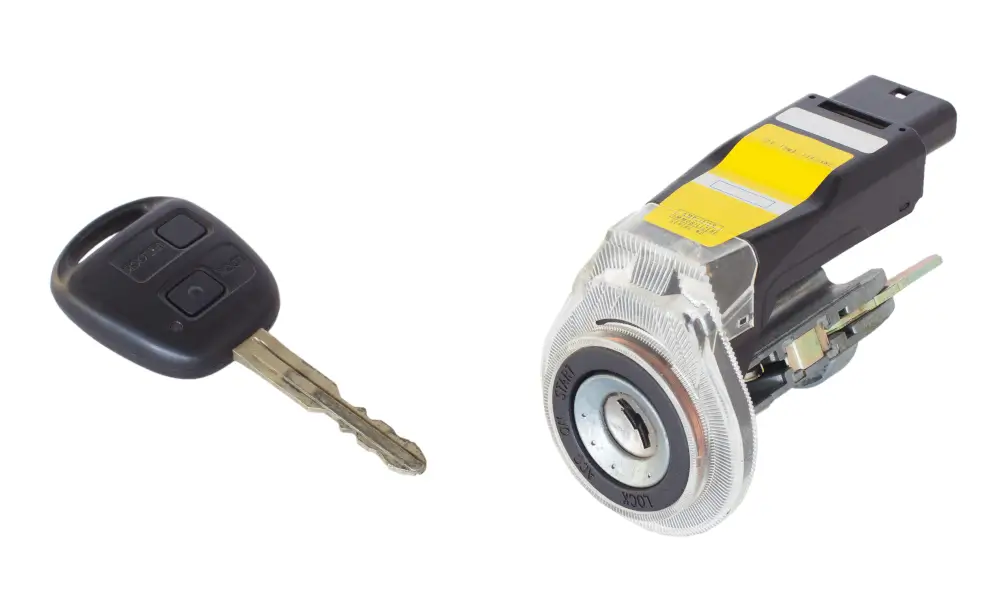
The photo shows the assembly out of the car. The round face on the left is the ignition cylinder itself, the part your key enters. Behind it sits the electrical switch, the black body that actually tells the starter to work. The white ring wrapped around the barrel is the immobilizer antenna, which reads the chip in your key. Three jobs, one housing, and each one fails in its own way.
| What You Notice | Likely Culprit |
|---|---|
| Key will not turn at all | Steering lock, key, or cylinder |
| Key turns, nothing happens | Electrical switch |
| Cranks but will not catch | Immobilizer or chip |
| Key sticks or comes out rough | Worn key or worn cylinder |
That table is the whole diagnostic tree in miniature. A dead ignition cylinder and a dead electrical switch feel completely different from the driver’s seat, and the immobilizer failure feels different again. When someone quotes you a price without asking which of those four things is happening, they are not diagnosing. They are guessing with your money.
What Is Happening Inside the Ignition Cylinder
A quick look inside makes everything else make sense. An ignition cylinder is a row of small spring loaded wafers sitting in a brass plug. Each wafer pokes up into a channel and physically blocks the plug from rotating. Your key carries a series of cuts at different depths, and each cut lifts its matching wafer to exactly the height where it clears that channel. When every wafer lines up at once, the plug turns and the car starts. When one does not, nothing moves at all.
That design explains every symptom in this guide. Debris stops a wafer from lifting fully. A worn key lifts them almost far enough. Worn wafers inside the ignition cylinder sit at heights your key was never cut for. All three produce the identical experience from the driver’s seat, which is a key that slides in and then refuses to turn, and that is exactly why diagnosis beats guessing.
Five Reasons Your Key Will Not Turn
Narrowing further, here are the actual causes in rough order of how often they show up. Read them in order, because the free ones are at the top and there is no sense paying for the fifth when your problem is the first.
| Cause | Tell |
|---|---|
| Steering wheel lock bound | Wheel feels locked hard one way |
| Not fully in park | Automatic, shifter sits between gears |
| Worn or wrong key | Spare key works fine |
| Debris in the keyway | Key will not seat all the way |
| Worn ignition cylinder | Gradual, both keys, got worse slowly |
Notice the pattern in that last column. Sudden problems are usually mechanical binding or debris. Gradual problems that crept up over months are almost always wear, either in the key or in the ignition cylinder itself, and an ignition cylinder wears on a much slower clock than anything else on this list. If you can remember the exact day it started, that points one direction. If you cannot, it points the other.
The shifter one catches more people than it should. Automatics use an interlock that refuses to release the key unless the transmission is genuinely in park, and a shifter parked lazily between detents reads as not in park. Nudge it firmly into park, then try again. It costs nothing to rule out and it is embarrassing to pay someone to do it for you.
What to Try Before You Call Anyone
Everything in this section is safe, free, and rules out the cheap causes. None of it can damage your car when done gently. The one rule: gently. Force is what turns a twenty dollar problem into a snapped key and a bad afternoon.
| Try This | Why It Works |
|---|---|
| Rock the wheel, turn the key | Unloads the steering lock pin |
| Push shifter firmly to park | Satisfies the interlock |
| Try your spare key | Instantly proves key versus car |
| Take everything off the ring | Removes sideways load |
| Check the battery | Some cars bind with low voltage |
The steering wheel trick deserves its own note because it is the single most useful thing on this page. Park on a slope or turn the wheel after shutting off, and the lock pin can drop into its slot under load. It jams. The key then has to fight the entire weight of the front wheels, and it will lose. Light pressure on the key while rocking the wheel side to side lets the pin slip free.
The spare key test is the other one worth doing properly. If the spare turns and the daily key does not, your car is fine and you need a key, not repair work. That is a cheap outcome and a common one. If both keys fail identically, the problem lives in the car, and ignition cylinder repair moves to the top of the list.
When the Key Is the Real Problem
Here is the part most drivers never think about. Your key is brass. The wafers inside the lock are harder. Every single turn scrapes a little metal off the key, and after ten or fifteen years of daily use the sharp cuts that once lifted each wafer to exactly the right height have rounded into soft hills. The key still looks like a key. It just no longer speaks the language the lock understands.
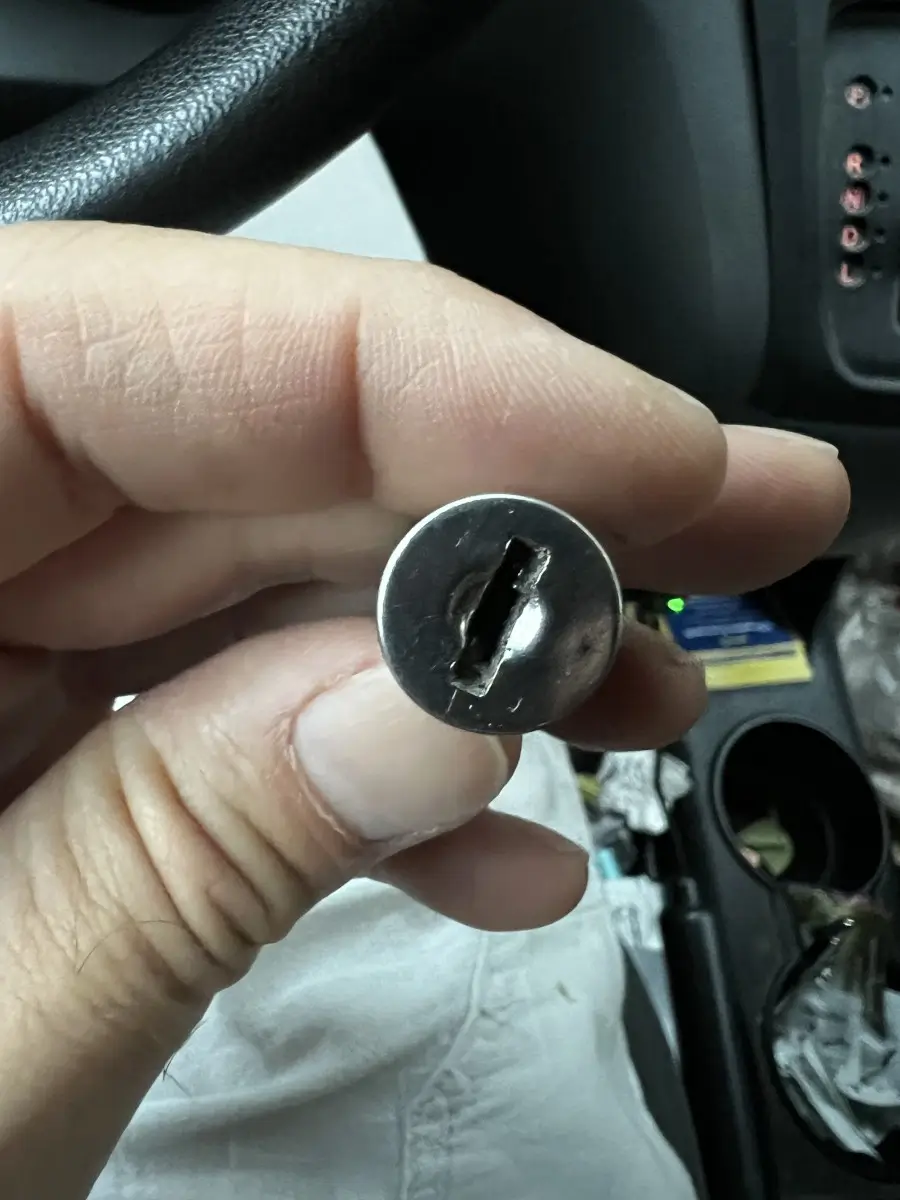
That cylinder face came off one of our own service calls rather than a stock photo library, and the chewing around the mouth of the keyway is what a decade of daily turning under a loaded keyring actually leaves behind. Wear runs both directions. The key gets softer edges, the ignition cylinder keyway gets sloppier, and the two of them drift apart until one morning the whole arrangement quits agreeing.
This is why a fresh key cut from your car’s original code often fixes a problem people were certain was terminal. The new key is cut to factory specification instead of copied from your worn one, which is the difference between a fix and a slower version of the same failure. Copying a rounded key produces a rounded key. Cutting to code produces the key the lock was built for.
There is a hard limit to that trick, though. Once the wafers themselves have worn, no key on earth aligns them, because the ignition cylinder moved the target. At that point you are into genuine ignition cylinder repair, and the honest tell is simple: if a brand new key cut to code still will not turn, the ignition cylinder is the problem and no key will rescue it.
Key will not turn and you are stuck?
We diagnose before we quote, and the work happens where your car sits. No tow, no dealership appointment, no guessing.
Call us now: (870) 515-2145
What Actually Comes Out of the Column
When the diagnosis lands on the ignition cylinder itself, here is what happens next. The steering column trim comes off, the assembly gets released from the housing, and the failed ignition cylinder comes out in one piece. It is a bench job performed in your driver’s seat, and it is far less dramatic than most people picture.
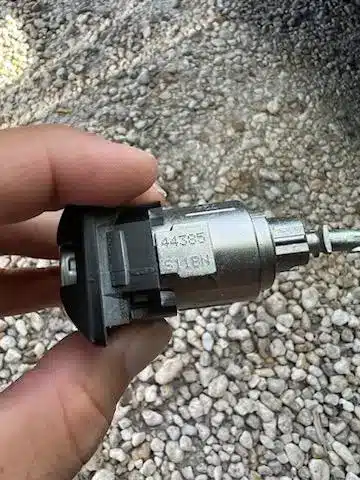
That is the part, out of the car, on another of our calls. Small, unremarkable, and responsible for your entire morning going sideways. Note the casting numbers stamped into the body. Those matter, because the replacement has to match the housing, the linkage, and in many vehicles the electrical connector behind it.
Two paths exist from here. The better one, when the vehicle allows it, is rebuilding the ignition cylinder so it accepts your existing key. New wafers, your original key, no new keys to carry and nothing to reprogram. The other path is a full replacement assembly, which is necessary when the housing is damaged or the design does not permit a rebuild. A shop that only ever offers the second option is telling you which tools it owns.
Rebuild or Replace: The Choice That Decides Your Bill
This fork sets your price, so it is worth understanding before anyone quotes you. An ignition cylinder rebuild means the technician takes the plug apart, fits fresh wafers and springs, and keys the rebuilt unit back to your original key. You leave with the same key you have carried for years and nothing to reprogram. An ignition cylinder replacement means a complete new assembly goes into the column, which usually brings a new key and a programming step with it.
Which path you get is decided by your vehicle, not by preference. Some designs come apart cleanly and some were never meant to, and a damaged housing forces an ignition cylinder replacement regardless of what anyone would prefer. The honest version of this conversation sounds like an explanation of why your particular car allows one option and not the other. The dishonest version skips straight to replacement because it carries the bigger ticket.
Either way, do not let anyone drill your steering column as a first move. Drilling is a legitimate last resort on a seized lock, and a terrible opening act. If a technician reaches for a drill before trying anything else, you are watching someone sell a replacement they were always going to sell.
The Step Everyone Forgets: Making the Car Trust the Key
Mechanical work is only half of a modern job. Nearly every vehicle built since the late nineties carries an immobilizer, which means the car checks for a chip in your key before it will let the engine run. Replace the ignition cylinder and hand the customer a new key, and the engine will crank happily and then die two seconds later, every time, until the car is taught to accept it.
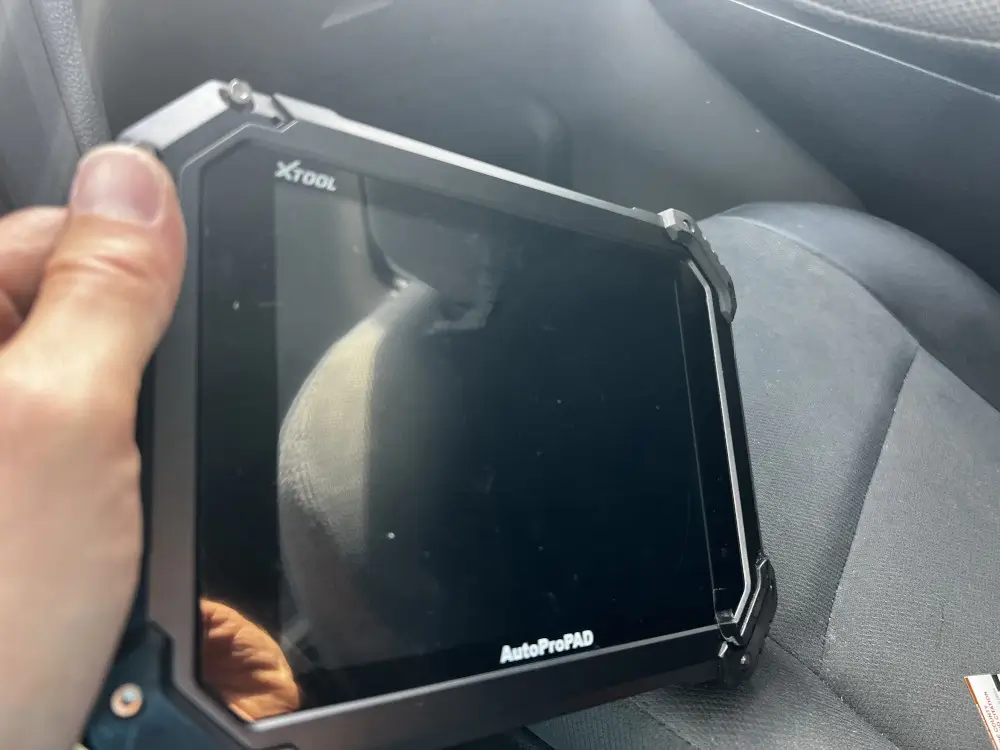
That tablet is why the whole job finishes in one visit in your driveway. It talks to the vehicle, registers the new key, and confirms the immobilizer accepts it before anyone drives away. Without it, a mechanically perfect repair is a car that still will not start, which is a distinction lost on nobody standing in a parking lot at 6 pm.
This is also the honest dividing line between a locksmith and a general mechanic on this particular job. Plenty of good mechanics can pull a column apart. Fewer carry key cutting and programming equipment in the vehicle, which is the difference between finishing and referring you somewhere else. If your problem is the chip side rather than the mechanical side, our guide to transponder key programming covers that half in detail.
Pine Bluff Realities: Older Fleets and Long Commutes
Ignition cylinder wear is a mileage and years problem, which makes it a Pine Bluff problem more than it is a Bentonville problem. Vehicles here get kept, maintained, and driven, and a car with fourteen years of turns in it is a car whose ignition cylinder has done fourteen years of work. The failures we see are not abuse. They are arithmetic.
Geography adds to it. Plenty of Jefferson County drivers put real highway miles on daily, running 65 or 530 toward Little Rock and back, and every one of those days ends with a key turning twice. Shift work at the industrial and rail employers around town means those turns happen at hours when a dealership service department is dark. A car that will not start at 5 am is a car that needs somebody mobile, not an appointment on Thursday.
There is a local wrinkle worth naming too. Pine Bluff spreads wide, from the neighborhoods around the mural district and downtown out to the county roads, and a failure at the far end of that is a long way from a tow yard. Towing a car for an ignition cylinder that comes out of the column in your own driveway is money set on fire. Our automotive locksmith service exists precisely to keep the car where it is.
One more thing specific to older vehicles: check for open recalls. Ignition switch defects have been the subject of real safety recalls affecting the switch behind the ignition cylinder, affecting millions of cars, and the repair is free when your vehicle is covered. Run your VIN through the federal recall lookup before you pay anybody. It takes two minutes and it occasionally saves the entire bill.
3
Parts that can fail, only one is costly
0
Tows needed for this repair
24/7
Including shift-change hours
The Warning Signs Worth Acting On
Ignition cylinders rarely die without notice. They get stiff, then they get selective, then they quit entirely. The trouble is that early signals are easy to normalize, because a key that needs a little wiggle today needs the same wiggle tomorrow, and eventually you stop noticing you are doing it. Six months on you are doing it with both hands and calling it normal.
Take stiffness seriously the first time it shows up. An ignition cylinder that has started binding is running on a schedule, and the only open question is whether you meet that schedule in your own driveway on a Tuesday afternoon or in a dark parking lot at midnight. The repair is the same repair either way. The circumstances are entirely your call.
What Moves the Price
Pricing here is not one number, because the three failures above are three different jobs, and only one of them is ignition cylinder repair in the strict sense. A fresh key cut to code sits at the low end of automotive work. An ignition cylinder rebuild lands in the middle. A full ignition cylinder replacement with programming sits at the top, because the part costs real money and the labor is longer. Across this region those jobs commonly run from under a hundred dollars at the key end to several hundred at the full replacement end, with the middle sitting between.
Four things move you inside that spread: whether the vehicle allows an ignition cylinder rebuild or forces a replacement, whether the part is common or ordered, whether programming is required, and what the column design demands in labor. All four are knowable during the phone call, which is why you should expect to be asked questions rather than handed a number.
Two related costs live in their own guides rather than here, because they deserve the room. If your keys are gone entirely rather than not turning, pricing works differently and our breakdown of replacement pricing by key type covers it. If what you actually need is somebody to get you into a locked vehicle, the service call pricing guide handles that. Different problems, different money.
Worth saying plainly: the cheapest quote on the phone is frequently the most expensive outcome. An outfit without cutting and programming equipment aboard has one profitable move available to it, and that move is a full ignition cylinder replacement whether or not your car needed one. Paying a fair price to somebody who can rebuild is routinely cheaper than a bargain from somebody who can only swap parts and charge for keys.
The rule that holds across all of them: a legitimate quote follows a diagnosis, never precedes one. Anyone naming a firm repair price before establishing whether your problem is a steering lock, a worn key, or a failed ignition cylinder is not pricing your job. They are pricing the job they hope to sell you.
How to Make the Next One Last Longer
Almost everything that kills an ignition cylinder early is preventable, and it comes down to one habit. Look at your keyring. If a fob, a house key, a work badge, a bottle opener, and a gym tag are all hanging off the key while it sits in the column, that weight is pulling sideways on a precision part every time you drive over a bump. Over years, that side load is what wears the ignition cylinder into a shape your key no longer fits.
Drive with the ignition key separate, or at minimum on a light ring. It is the cheapest maintenance in the entire vehicle and nobody does it. The second habit is almost as easy: never force a key that has started feeling stiff. Stiffness is an ignition cylinder warning that costs a service call to heed and a snapped key to ignore. If one does snap off in the lock, our guide to broken key extraction covers what happens next.
Third, get a fresh key cut to code before you need one. If your daily key is fifteen years old and visibly polished smooth, it is actively sanding the ignition cylinder wafers every day. Replacing that key early is a small bill that postpones a large one, and it gives you a known-good key for the spare test the next time something acts strange.
Last, take the warning signs seriously. A key that needs jiggling, an ignition cylinder that only turns in one particular position, a key that comes out gritty. Those are the ignition cylinder telling you its remaining life is now measurable. People who call at that stage almost always have more options and smaller bills than people who call from a parking lot after it finally quits. If you are already stranded, our emergency locksmith service runs around the clock, and if the trouble is a lockout rather than a lock failure, the car lockout and fob guide is the right starting point.
Want it diagnosed before you spend anything?
Tell us what the key does, what the wheel does, and whether the spare works. That conversation usually narrows it to one part before anyone rolls a wheel, anywhere in Pine Bluff or Jefferson County.
Call us now: (870) 515-2145
Pine Bluff Ignition Questions, Answered
The questions Pine Bluff drivers ask most when a key stops turning. If yours is not here, call (870) 515-2145 and describe what the key is doing. Diagnosis over the phone costs nothing and often saves a visit.
Why will my key not turn in the ignition?
Usually the steering wheel lock is bound against the pin, which you can free by rocking the wheel gently while turning the key. If that fails, the next suspects are a worn key or a worn ignition cylinder. Try your spare first, because a spare that works proves the car is fine and you simply need a key.
Can a locksmith fix an ignition cylinder in Pine Bluff without towing my car?
Yes, this is mobile work. A properly equipped locksmith removes the column trim, services or replaces the lock, cuts a key if needed, and programs it to the immobilizer where your car sits. Towing a vehicle to a dealership for a part that comes out in your driveway adds cost without adding anything else.
What does ignition cylinder repair cost around Pine Bluff?
It depends on which of three jobs you need. A fresh key cut to code is the least expensive, a rebuild of the lock sits in the middle, and a full replacement with programming costs the most. Expect real questions on the phone first, because an honest quote follows a diagnosis rather than preceding one.
My key turns but the car will not start. Is that the same problem?
No, and this distinction matters. If the key turns freely, the mechanical lock is doing its job, so the trouble is the electrical switch behind it or the immobilizer reading the chip in your key. Different parts, different repair, and worth telling whoever you call, since it changes what they bring.
Does a heavy keyring really wear out an ignition?
Yes, and it is the most common preventable cause we see. Weight hanging off the key applies constant sideways load to a precision part every time you hit a bump, wearing the wafers over years until your key no longer aligns them. Driving with the ignition key on a light ring genuinely extends its life.


